Independent analysis reveals that approximately 30% of peptide samples from grey-market sources are mislabeled or contaminated, yet even high-purity, clinical-grade sequences are at risk the moment they leave a controlled laboratory environment. For the disciplined practitioner, traveling with peptides safely requires more than a standard cooler; it demands a sophisticated command of both international regulatory law and molecular physics. You likely understand the anxiety of approaching a security checkpoint with delicate, reconstituted vials. The threat of TSA confiscation or the silent degradation of your protocol due to temperature fluctuations is a legitimate concern for anyone serious about their long-term performance optimization.
This clinical guide provides the rigorous protocols necessary to ensure your supplies remain both legally compliant and biologically active. We will detail the specific TSA exemptions for medically necessary liquids, the critical requirements for maintaining molecular integrity through phase-change materials, and the evolving regulatory landscape following the April 2026 FDA reclassifications. By the conclusion of this brief, you'll possess the data-driven framework required to manage high-stakes transit with absolute precision and professional confidence.
Key Takeaways
- Define the specific TSA exemptions for medically necessary liquids to ensure your injectable supplies pass through domestic checkpoints without incident.
- Master the science of cold chain management for traveling with peptides safely, utilizing phase-change materials to protect delicate molecular structures from thermal degradation.
- Establish a proactive declaration strategy for international customs based on the 2026 regulatory updates for metabolic research sequences.
- Identify and mitigate environmental stressors at your destination, including UV light and humidity, to maintain clinical-grade stability in hotel environments.
- Optimize your metabolic results by aligning travel logistics with the Peptiva Protocol, ensuring that transit-related variables don't disrupt your fat loss trajectory.
Navigating TSA and Domestic Air Travel Protocols
Domestic air travel with specialized sequences requires a meticulous understanding of federal regulations. Under current 2026 TSA guidelines, peptides are recognized as medically necessary liquids. This status grants them an exemption from standard volume restrictions, provided the practitioner adheres to specific declaration protocols. Successfully traveling with peptides safely begins with a disciplined approach to the security checkpoint.
When you approach the screening area, you must proactively inform the TSA officer of your supplies before the bags enter the X-ray belt. Do not wait for the technician to flag the container. This proactive disclosure establishes a professional baseline and often preempts the need for invasive secondary screenings. If an officer requests a closer inspection, maintain clinical composure. State clearly that the items are medically necessary liquids and injectables. Having your documentation organized and accessible is not just a suggestion; it is a requirement for the serious practitioner.
The 3-1-1 Rule Exemption for Medical Liquids
Standard passengers are bound by the 3-1-1 rule, which limits liquids to 3.4 ounces. You are not. TSA explicitly exempts medically necessary liquids from these volume constraints. This exemption covers reconstituted vials and the bacteriostatic water essential for your protocol. TSA defines a "reasonable quantity" as an amount consistent with your trip duration, typically interpreted as a 30 to 90 day supply.
Be aware of the risks associated with "Research Use Only" labeling. While the FDA's April 23, 2026, reclassification moved many substances like BPC-157 and Ipamorelin toward regulated compounding status, products labeled for research can still trigger scrutiny. Such labels imply the substances are not intended for human consumption, which may conflict with your claim of medical necessity. For those committed to traveling with peptides safely, sourcing from licensed pharmacies with professional labeling is the only way to ensure a seamless transit.
Syringes and Sharps Logistics
Unused syringes are permitted in carry-on bags when they are accompanied by the injectable medication. To adhere to airline safety standards, any used sharps must be secured in a dedicated, puncture-resistant container. This is a non-negotiable safety mandate for the disciplined traveler.
You must never place your primary peptide supply in checked baggage. The cargo hold is subject to extreme temperature variances and mechanical stressors that can compromise the molecular integrity of your sequences. Maintaining rigorous cold chain management is only achievable when the supplies remain in your immediate possession within the pressurized, climate-controlled cabin. Losing a checked bag containing high-value, lab-tested peptides is a risk that no serious individual should accept.
Protecting Molecular Integrity: Cold Chain Management
The primary threat to peptide efficacy during transit is not the security checkpoint, but the silent process of molecular degradation. Peptides are essentially short chains of amino acids held together by fragile peptide bonds. When these molecules are exposed to thermal fluctuations or mechanical agitation, they undergo denaturation. This process alters their three-dimensional structure, rendering them biologically inert and potentially immunogenic. Traveling with peptides safely is a commitment to preserving this structural integrity from the moment you leave your laboratory or pharmacy.
Mechanical stressors are frequently overlooked. The vibrations of a long-haul flight and the physical handling of luggage can disrupt the stability of sequences, particularly those with complex folding patterns. Additionally, while standard airport X-rays are generally considered safe for brief exposures, the cumulative effect of radiation and the pressure differentials in aircraft cabins pose risks for pre-filled syringes. Reconstituted vials are particularly vulnerable to pressure changes, which can compromise the vacuum seal and lead to contamination or leakage.
Lyophilized vs. Reconstituted Stability Windows
Lyophilized (freeze-dried) peptides represent the gold standard for travel logistics. In their powdered state, these molecules are significantly more resistant to thermal stress. Most fat-loss sequences, such as Ipamorelin or CJC-1295, can maintain stability at room temperature for several days when lyophilized, though refrigeration remains optimal. Conversely, reconstituted solutions are highly volatile. Once a peptide is mixed with bacteriostatic water, its shelf life outside of a strict 2-8°C range drops to hours.
For international transit, we recommend transporting your sequences in their lyophilized form and performing the mixing process only upon arrival. You can reference our technical guide on how to reconstitute peptides to ensure your post-travel setup adheres to clinical standards. If you require assistance in tailoring a travel-friendly regimen, a personalized medical assessment can provide the necessary oversight.
Advanced Cooling Technologies for Travel
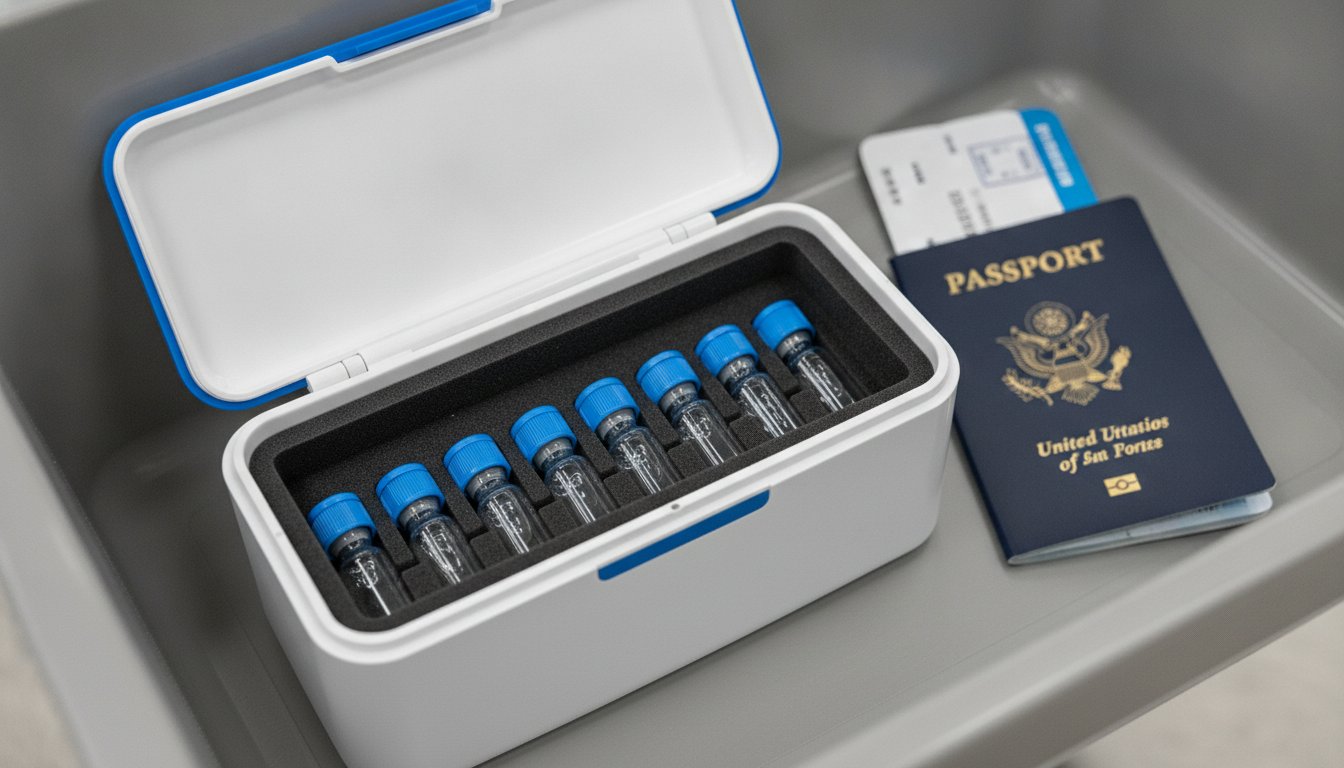
Traditional gel packs are insufficient for high-stakes transit. They often freeze the product initially and then lose their cooling capacity rapidly, creating a dangerous temperature spike. Professional practitioners utilize Phase Change Materials (PCM). These substances are engineered to maintain a precise temperature range, such as 2-8°C, for up to 48 hours. When paired with a vacuum-insulated medical travel case, PCM inserts provide a stable thermal environment that gel packs cannot replicate. We also advise using a compact digital hygrometer with an external probe. This allows you to monitor internal temperatures in real-time without opening the case and compromising the thermal seal. Implementing these advanced cooling technologies is the final step in traveling with peptides safely across multiple time zones.
International Borders and Customs Compliance
Crossing a sovereign border with biological sequences demands a higher level of regulatory precision than domestic transit. While TSA focuses on immediate flight safety, customs officials are concerned with the legality of the substance itself and its intended use. Traveling with peptides safely on an international scale is predicated on total transparency. Attempting to obfuscate the nature of your supplies is a high-risk strategy that often leads to permanent confiscation, fines, or legal penalties. Honesty, backed by clinical documentation, remains the only viable legal strategy for the serious practitioner.
The global landscape is currently in flux. Following the April 23, 2026, FDA removal of several peptides from Category 2, international authorities are increasingly distinguishing between regulated, physician-supervised therapies and unregulated research chemicals. This shift toward clinical legitimacy helps travelers in many jurisdictions, yet some regions remain notoriously difficult. Australia and the United Arab Emirates, for instance, maintain exceptionally strict controls on metabolic substances. Entering these regions without an explicit, verified clinical framework is ill-advised and carries a high probability of supply loss.
Clinical Documentation and Medical Letters
A personalized medical assessment serves as the foundation of your legal defense at any border. A professional travel letter from your healthcare provider must detail the medical necessity of the sequences, your specific dosage, and the duration of your stay. This letter should explicitly match the nomenclature on your vial labels and your government-issued identification. We also recommend carrying lab-verified purity reports. These documents prove the substance is exactly what you claim it is, which is vital given that independent analysis shows 30% of grey-market peptides are mislabeled or contaminated. Providing this level of data signals that you are a disciplined individual following a structured, safe protocol.
Personal Use Quantities and Import Rules
Most Western nations, including the UK, Canada, and various EU members, typically allow a 30 to 90 day supply for personal use. The distinction between "research grade" and "prescribed" is critical at the customs line. Peptides labeled for research use only exist in a legal grey area that customs agents frequently interpret as an attempt to bypass health regulations. If you are traveling with peptides safely, ensure your supply is clearly marked for personal medical use under physician oversight. Non-disclosure at a "nothing to declare" line is a tactical error. If you are stopped, the lack of a proactive declaration can be framed as an intent to smuggle. Proactive disclosure, supported by a professional clinical protocol, positions you as a compliant patient rather than a regulatory risk.

On-Site Logistics: Storage and Administration
Arrival at your destination marks the beginning of a stationary risk phase. Success in traveling with peptides safely depends on your ability to maintain laboratory-grade conditions in a hotel environment. While transit risks are largely mechanical and thermal, on-site logistics introduce environmental variables like UV exposure and inconsistent humidity. Peptides are photosensitive; prolonged exposure to hotel room lighting or direct sunlight can trigger rapid degradation. Always store your supplies in their opaque travel cases, even when refrigerated, to provide a secondary barrier against light and moisture.
Hygiene protocols must remain uncompromising. Hotel surfaces are not sterile environments. Before any administration, establish a dedicated clean zone on a non-porous surface. Use a fresh sterile barrier, such as a clean towel or medical mat, to organize your supplies. If your supplies are compromised, perhaps due to a power outage or accidental freezing, don't attempt to salvage the sequence. A denatured peptide is biologically useless and carries an increased risk of an adverse immune response. Professional practitioners always carry a 20% surplus of lyophilized vials as a contingency for such events.
Hotel Refrigeration Risks and Solutions
Most hotel mini-fridges are designed for beverage storage, not pharmaceutical precision. These units often lack accurate thermostats and can fluctuate wildly. The mini-fridge freeze is a common failure point where the back cooling element drops below 0°C, causing irreversible peptide crystallization. Never place vials near the rear wall of the unit. Additionally, avoid hotel cool boxes that lack compressors, as they rarely maintain the 2-8°C range required for reconstituted sequences. If the refrigeration is suspect, use a vacuum-insulated flask filled with a 50/50 ice-water bath. This method provides a stable, predictable 0-4°C environment that is far safer than an uncalibrated fridge.
Sanitization and Sharps Disposal Abroad
Maintaining a rigorous BPC-157 peptide healing protocol during high-activity travel requires foresight regarding consumables. In many foreign territories, sourcing 70% isopropyl alcohol swabs or sterile water can be difficult. You should pack a surplus of these supplies to avoid local supply chain issues. For disposal, don't discard needles in standard hotel waste bins. This is a significant biohazard. If a dedicated sharps container isn't available, use a puncture-resistant plastic bottle with a screw-top lid. Label it clearly and request disposal assistance from a local pharmacy or medical clinic upon departure. For those who require professional oversight to manage these complexities, a personalized medical assessment is the best way to ensure your protocol remains intact while abroad.
Sustaining Metabolic Progress: The Peptiva Advantage
Travel is a physiological stressor. The disruption of sleep cycles and the elevation of systemic cortisol can blunt the signaling pathways of growth hormone secretagogues. Integrating travel logistics into a broader framework of metabolic optimization ensures that the physiological stressors of transit don't compromise the progress you've achieved through disciplined adherence. Traveling with peptides safely is only half the battle; the other half is ensuring those peptides remain effective within a shifting biological environment.
The transition between time zones often leads to circadian dysregulation, which directly impacts metabolic rate and insulin sensitivity. When you follow The Peptiva Protocol, you aren't just managing a cooler bag; you're managing a complex biochemical intervention. Clinical oversight becomes vital when your standard routine is sequestered by flight schedules and international borders. Accessing professional coaching allows for real-time pivots in your regimen, ensuring that your metabolic momentum remains constant regardless of your geographic location.
Travel-Friendly Metabolic Protocols
Success requires adjusting injection timing to align with your destination's day-night cycle. This synchronization helps mitigate the metabolic stall often associated with jet lag. Maintaining the specific peptides for metabolism and fat loss sequence is critical, as consistency is the primary driver of receptor sensitivity. Through 1-on-1 coaching, practitioners can receive data-driven guidance on how to titrate dosages or shift administration windows to accommodate long-haul transit without inducing systemic fatigue.
Ensuring Long-Term Success with PeptivaFit
The security of using lab-tested peptides extends beyond molecular stability. In an era where 30% of grey-market samples are mislabeled or contaminated, having verifiable, clinical-grade sequences provides a layer of protection during regulatory scrutiny. If a customs official questions the legitimacy of your supplies, the ability to provide professional documentation and purity reports is an unmatched advantage. We offer personalized medical assessments to provide the necessary health clearances for international travel, ensuring your metabolic future is secure.
Before your next departure, utilize this final checklist to ensure total compliance and integrity:
- Confirm all sequences are in lyophilized format for maximum thermal resistance.
- Verify that travel letters from your healthcare provider match your identification exactly.
- Pack a 20% surplus of sterile consumables to account for transit delays.
- Pre-chill your vacuum-insulated travel case for at least 6 hours before departure.
- Coordinate with your coach to finalize your adjusted administration schedule.
By treating traveling with peptides safely as a clinical discipline rather than a logistical chore, you maintain the high-level control required for elite performance optimization.
Mastering the Logistics of Global Metabolic Continuity
Successfully traveling with peptides safely requires a transition from passive transport to active clinical management. You've learned that regulatory compliance is not a matter of chance; it's the result of proactive declaration and rigorous documentation. Protecting your molecular investment demands a sophisticated command of cold chain logistics and on-site environmental control. By prioritizing lyophilized storage and utilizing phase-change materials, you ensure that your metabolic sequences remain biologically active regardless of transit duration.
The complexity of these protocols shouldn't be a barrier to your performance goals. Our framework provides the precision needed to navigate international borders with absolute confidence. Through lab-verified peptide purity, personalized medical oversight, and comprehensive 1-on-1 coaching, we provide the infrastructure for your continued success. You don't have to manage these variables alone. Secure your metabolic progress with the Peptiva Protocol and maintain your trajectory toward peak optimization. Your dedication to the science of wellness deserves a support system that is as disciplined as you are.
Frequently Asked Questions
Can I carry reconstituted peptides in my carry-on bag?
Yes, you can carry reconstituted peptides in your carry-on luggage because they are classified as medically necessary liquids. This specific classification exempts them from the standard 3.4-ounce volume restriction mandated by the 3-1-1 rule. You must declare these items to TSA officers at the security checkpoint before screening begins. While permitted, transporting sequences in a liquid state increases the risk of thermal degradation, so using a vacuum-insulated medical cooler is mandatory for maintaining molecular stability.
Does TSA require a prescription for peptides in 2026?
TSA regulations don't explicitly mandate a physical prescription for domestic travel, but carrying one is a clinical best practice for traveling with peptides safely. A professional medical letter or prescription label helps verify the legitimacy of your supplies during secondary screenings. Following the April 2026 FDA reclassifications, having documentation that links your peptides to a personalized medical assessment provides an essential layer of regulatory protection and prevents the unnecessary confiscation of high-value sequences.
How long can peptides stay at room temperature during travel?
Lyophilized peptides can generally remain at room temperature for 24 to 72 hours without significant degradation, depending on the specific sequence and ambient conditions. However, reconstituted solutions are far more volatile and shouldn't exceed two to four hours outside of a strict 2-8°C environment. To ensure you're traveling with peptides safely, always prioritize the freeze-dried powder format for transit and only perform the reconstitution process once you've secured reliable refrigeration at your destination.
Will airport X-ray machines damage my peptide vials?
Standard airport X-ray machines are unlikely to cause immediate molecular damage to peptide vials during a single transit event. The radiation levels used for carry-on screening are insufficient to break the covalent bonds of amino acid chains. However, cumulative exposure over multiple international legs or high-energy checked baggage scans may pose a theoretical risk to delicate sequences. For maximum security, you can request a manual visual inspection of your medical supplies to bypass the X-ray equipment entirely.
What should I do if my hotel room does not have a reliable refrigerator?
If a reliable refrigerator is unavailable, you should utilize a high-quality vacuum-insulated flask filled with a 50/50 ice-water bath. This method creates a stable 0-4°C environment that protects against the temperature spikes and freezing risks common in uncalibrated hotel mini-fridges. You must ensure the vials aren't in direct contact with the ice to prevent irreversible crystallization. Replacing the ice every 12 to 24 hours maintains the cold chain until you can access professional storage.
Are peptides legal to take to Europe or Australia for personal use?
Most European nations allow a 90-day supply of peptides for personal use when supported by a valid prescription and clinical documentation. Australia maintains significantly more restrictive laws and often requires a specific Import Permit for metabolic substances. It's your responsibility to verify the current 2026 regulations for your specific destination. Traveling with "research use only" products into these jurisdictions is a high-risk activity that frequently results in legal complications and permanent seizure of your items.
Do I need to declare my peptides at US Customs when returning home?
You must declare your peptides at US Customs when returning from international travel to remain in full legal compliance. Using the "nothing to declare" line while carrying biological sequences can be interpreted as an attempt to bypass federal health regulations. Proactive disclosure, supported by your personalized medical assessment and pharmacy labels, establishes you as a compliant traveler. Customs officials are primarily concerned with commercial intent, so demonstrating that the supply is for personal use is critical.
How do I pack syringes safely for international flights?
Unused syringes must be packed in your carry-on luggage and must be accompanied by the injectable peptide medication to meet security requirements. Packing them in checked bags is discouraged due to the risk of luggage loss or mechanical damage. For used needles, you must use a puncture-resistant sharps container that meets airline safety standards. If a professional container is unavailable abroad, a heavy-duty plastic bottle with a secure screw-top lid serves as an acceptable temporary alternative for biohazard containment.

![Shelf Life of Reconstituted Peptides: A Clinical Reference Guide [2026]](https://getautoseo.com/storage/hero_images/shelf-life-of-reconstituted-peptides-a-clinical-reference-guide-2026.jpg?v=b8ed5173acaa)
