

High-performance leadership is no longer just a test of strategy; it's a test of molecular signaling integrity. You've likely noticed that the disciplined dieting and rigorous exercise that once sustained your peak performance no longer yield the same metabolic returns. The persistent brain fog and midday energy crashes you experience aren't failures of will. They're symptoms of a biological system struggling to keep pace with an uncompromising professional schedule. Peptide therapy for busy professionals has emerged as a sophisticated tool for those who require their biology to match their ambition.
You understand that time is your most finite resource, and you can't afford a health regimen that feels like a second job. This guide demonstrates how clinician-supervised peptide protocols allow you to reclaim metabolic efficiency and cognitive clarity through data-driven, streamlined interventions. We'll examine the 2026 regulatory landscape, the necessity of lab-verified supplies, and how the Peptiva Protocol provides a structured path toward restored metabolic flexibility. By the end of this discussion, you'll see how to outsource the complexities of health management to a scientific framework designed for the elite professional.
Key Takeaways
- Understand how peptide therapy for busy professionals bypasses the "Executive Metabolic Trap" by restoring endogenous signaling patterns rather than following generic fitness trends.
- Identify the specific synergy between Growth Hormone Secretagogues and mitochondrial-derived peptides to optimize cellular energy production and cognitive endurance.
- Learn the rigorous standards for identifying lab-verified peptides and why a personalized medical assessment is a non-negotiable requirement for clinical safety.
- Discover how to integrate sophisticated health management into a demanding schedule using a streamlined five-minute daily protocol and precise reconstitution techniques.
- Explore the Peptiva Protocol as a disciplined, expert-led strategy to outsource metabolic complexity and achieve sustainable biological performance.
The Professional's Case for Peptide Therapy: Precision Over Trends
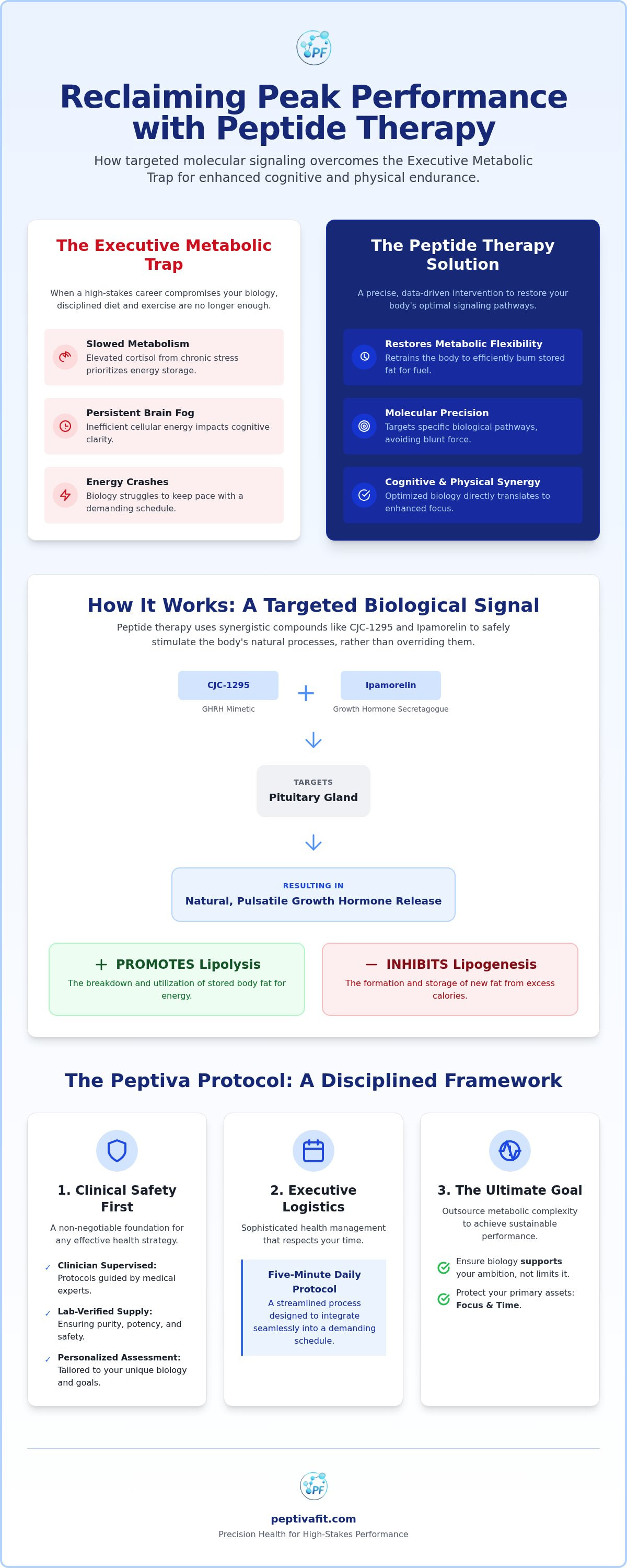
Peptide therapy represents a departure from the biohacking trends that often prioritize novelty over clinical efficacy. For the high-level professional, this isn't about chasing a physique for its own sake; it's about the precision restoration of endogenous signaling patterns that have been degraded by the demands of a high-stakes career. Unlike standard pharmaceutical interventions that often override natural processes, peptide therapy works by subtly modulating the body's existing biological pathways to encourage optimal function. It's a targeted approach designed to address specific physiological deficiencies with molecular accuracy.
Many leaders find themselves caught in the "Executive Metabolic Trap." This is a physiological state where chronic psychological stress, coupled with sedentary operational roles, creates an environment of refractory fat loss. Despite maintaining a disciplined caloric intake, the body's metabolic rate slows in response to elevated cortisol and disrupted circadian rhythms. Caloric restriction alone often fails because the underlying signaling, the instructions telling your body how to manage fuel, is compromised. Peptide therapy for busy professionals provides the necessary intervention to reset these signals, ensuring that your biology supports your lifestyle rather than resisting it.
Metabolic Signaling vs. Caloric Deficits
Traditional weight loss strategies frequently fail the high-stress professional because they ignore the hormonal adaptation to chronic pressure. When the body perceives a deficit in a high-cortisol environment, it prioritizes energy preservation over expenditure. Peptide signaling is the body's internal communication network. By utilizing growth hormone secretagogues, professionals can re-establish metabolic flexibility, allowing the system to transition efficiently between burning glucose and stored adipose tissue. This shift moves the focus from starving the system to optimizing it at a molecular level, providing a more sustainable return on your health investment.
The Cognitive Edge: Peptides and Executive Function
The intersection of metabolic health and executive function is absolute. Cognitive endurance isn't a separate entity from physical vitality; both rely on mitochondrial efficiency and stable blood glucose regulation. When cellular energy production is optimized through targeted protocols, the resulting mental clarity isn't just a subjective feeling but a measurable increase in focus and decision-making capacity. Peptide therapy for busy professionals offers a streamlined method to ensure that biological limitations don't dictate the ceiling of professional performance. Maintaining this metabolic integrity ensures that your primary assets, your focus and your time, remain sharp and protected.
Mechanisms of Action: How Peptides Support High-Stakes Performance
Effective peptide therapy for busy professionals relies on the strategic modulation of endogenous hormonal axes. By introducing specific amino acid sequences, we can influence the body's natural production of regulatory factors without the blunt-force physiological response of traditional drugs. It's vital to understand the potential benefits and safety concerns associated with these substances, as their efficacy depends entirely on precision and clinical oversight. Unlike standard pharmacology, peptides facilitate a nuanced signaling correction that respects the body's existing biological feedback loops. This approach ensures that the intervention acts as a catalyst for natural optimization rather than a disruptive external force.
The synergy between CJC-1295 and Ipamorelin is a primary example of this precision. CJC-1295 acts as a Growth Hormone Releasing Hormone (GHRH) mimetic, while Ipamorelin functions as a selective Growth Hormone Secretagogue (GHS). Together, they stimulate the pituitary gland to release growth hormone in a natural, pulsatile manner. This approach avoids the risks associated with constant exogenous stimulation, such as insulin resistance or pituitary shutdown. These compounds prioritize promoting lipolysis, which is the breakdown of fats, and inhibiting lipogenesis, the storage of new fat. By maintaining this balance, the body can mobilize energy reserves more effectively during high-demand professional cycles.
Growth Hormone Signaling and Body Composition
For the professional facing the "Executive Metabolic Trap," visceral adipose tissue is often the most stubborn obstacle. Clinical data suggests that a specific tesamorelin dosage is particularly effective at reducing deep abdominal fat, which is often linked to high-stress environments. This intervention prioritizes lean mass preservation, ensuring that metabolic rate remains elevated even during periods of restricted activity. If you're ready to move beyond generic advice, a personalized medical assessment can determine which signaling pathways require the most immediate attention.
Mitochondrial Health and Energy Sustainability
Daily cognitive output is directly tied to mitochondrial resilience. Chronic professional stress often leads to mitochondrial dysfunction, where the body's power plants fail to produce ATP efficiently. The mots c peptide functions as a mitochondrial-derived transcript that regulates metabolic homeostasis and enhances insulin sensitivity. By mimicking the cellular effects of physical exercise, MOTS-c supports energy sustainability and long-term longevity. This molecular repair mechanism is essential for maintaining physical and mental resilience, making it a cornerstone of peptide therapy for busy professionals who cannot afford a drop in performance. This targeted support allows for sustained focus without the crash associated with traditional stimulants.
Quality Control: Navigating Lab-Verified Standards and Safety
The pursuit of metabolic optimization often leads individuals into the "research peptide" market, a space where regulatory ambiguity can compromise biological safety. For those seeking peptide therapy for busy professionals, the distinction between industrial-grade research chemicals and clinical-grade substances is paramount. High-performance professionals don't accept sub-standard data in their careers; they shouldn't accept it in their health protocols. Identifying red flags, such as the absence of verifiable batch numbers or vague "not for human consumption" disclaimers, is the first step in maintaining molecular integrity. In 2026, the FDA's increased scrutiny of compounding pharmacies makes it even more critical to verify the source of your supplies. Regulatory compliance isn't just about following rules. It's about exercising the same level of professional responsibility in your health management that you apply to your business operations. Choosing an elite, insider service ensures that you aren't navigating these complexities alone.
The Importance of Third-Party Lab Testing
Every substance introduced into your biological system must be accompanied by a Certificate of Analysis (COA) from an independent, third-party laboratory. This document isn't just a formality. It's a verification of purity and potency. You should look for High-Performance Liquid Chromatography (HPLC) results and Mass Spectrometry (MS) data to ensure the absence of heavy metals or bacterial endotoxins. These contaminants can trigger systemic inflammation, negating the metabolic benefits you seek. PeptivaFit prioritizes lab-verified supplies specifically to eliminate these variables. This ensures the Peptiva Protocol remains a high-stakes health intervention rather than a biological gamble. Purity levels should ideally exceed 99% to minimize the risk of adverse immunological reactions and ensure that the molecular structure remains intact during the metabolic signaling process.
Clinical Oversight and Personalized Assessments
One-size-fits-all protocols are fundamentally flawed because they ignore your unique metabolic history and current physiological markers. A personalized medical assessment is a non-negotiable requirement for anyone serious about peptide therapy for busy professionals. Comprehensive blood work allows a clinician to identify existing deficiencies or contraindications that could impede your progress. Transitioning from self-experimentation to a clinician-supervised framework ensures that your protocol is adjusted based on data, not guesswork. This level of oversight provides the sophisticated control necessary to manage complex health regimens without sacrificing safety or efficiency. It's about moving from a "trial and error" mindset to a disciplined, expert-led strategy that values long-term stability. Utilizing 1-on-1 coaching allows you to outsource the management of these variables to a scientific mentor who understands the intersection of performance and safety.
Executive Logistics: Implementing Your Protocol on a Schedule
Efficiency is the defining characteristic of a successful executive operation. Integrating peptide therapy for busy professionals into a demanding schedule requires a transition from complex medical tasks to a streamlined five-minute daily routine. This isn't a hobby; it's a disciplined biological maintenance protocol. Success depends on removing friction through precise preparation and logistical foresight. By establishing a repeatable system, you ensure that health optimization doesn't become a source of decision fatigue or a drain on your cognitive bandwidth.
Reconstitution and Dosage Precision
Mastering how to reconstitute peptides with precision is foundational to maintaining molecular integrity. You'll need a dedicated kit of essential supplies: bacteriostatic water, alcohol prep pads, and insulin-grade syringes. Using a digital reconstitution calculator is a mandatory step to eliminate dosage errors that could compromise your metabolic results. Treat your administration area as a controlled environment where hygiene and accuracy are the primary metrics. This level of discipline ensures that the peptide therapy for busy professionals remains a clean, effective intervention without the risk of local irritation. Once a peptide is reconstituted, its molecular stability becomes fragile. You must avoid vigorous agitation or exposure to direct light, as these physical stressors can denature the delicate amino acid chains. To outsource the logistical burden of health management, you can book a single consultation call to refine your specific administration technique.
The Traveling Executive's Guide to Peptides
Maintaining a protocol while traveling requires strict adherence to the cold chain. Temperature-sensitive compounds must remain refrigerated to prevent degradation. For long-haul flights, utilize medical-grade portable cooling cases that maintain a consistent temperature between 2°C and 8°C. TSA regulations in 2026 continue to allow for the transport of medical supplies and refrigerated liquids, provided you carry a physical copy of your medical documentation. Digital copies are useful, but physical proof is often preferred by international customs officials. Navigating different time zones can disrupt your circadian rhythm, which affects hormonal signaling. Adjust your administration schedule to your destination's local time immediately upon arrival to help reset your metabolic clock. Consistency in administration timing is more important than matching a specific hour on the clock, allowing the protocol to adapt to your shifting professional demands without losing its molecular efficacy.
The Peptiva Protocol: A Disciplined Strategy for Optimization
The Peptiva Protocol is a systematic framework designed to replace the fragmented approach of modern wellness with a rigorous, data-driven methodology. For those utilizing peptide therapy for busy professionals, a structured strategy is the only way to ensure long-term metabolic stability without the risk of plateau. This isn't a collection of disparate suggestions; it's a disciplined sequence of interventions that respects the body's natural feedback loops. By treating health as an engineering problem rather than a series of trends, we provide a pathway for individuals who demand high-stakes results from their biology. Mastery of your metabolic health requires a departure from the mass-market advice that fails to account for the unique stressors of a high-performance career.
Structured Fat Loss and Metabolic Repair
This phase-based approach integrates peptides for metabolism and fat loss to ensure the system doesn't adapt to a single signal. Metabolic adaptation is the primary reason traditional dieting fails; the Peptiva Protocol bypasses this by rotating signaling pathways and adjusting dosages based on physiological feedback. Monitoring progress requires more than a simple scale measurement. We prioritize data points like visceral fat reduction, glycemic control, and subjective cognitive endurance. This ensures that every adjustment is based on measurable physiological shifts rather than guesswork. By cycling through specific metabolic signals, the protocol maintains molecular integrity and prevents the body from entering a defensive, energy-preserving state.
Leveraging Professional Coaching for Results
High-performance individuals understand the value of outsourcing specialized management to experts. Just as you employ consultants for business strategy, 1-on-1 coaching for your health reduces the cognitive load of navigating complex molecular data. PeptivaFit maintains a commitment to excellence by selecting only dedicated clients who are serious about their performance. This selective approach ensures that our resources are focused on those who value data over hype. For individuals who already have a framework in place but require strategic troubleshooting, a Single Consultation Call offers a targeted way to resolve specific protocol inefficiencies. The goal is a streamlined, medically-supervised health protocol that functions autonomously in the background of your life. You don't need another job; you need a scientific mentor to manage your biological assets. Apply for 1-on-1 Coaching to optimize your metabolic performance and secure the professional oversight necessary for sustained high-stakes output in 2026.
Mastering Your Molecular Performance
Professional success depends on the ability to maintain peak cognitive and metabolic output under sustained pressure. We've established that peptide therapy for busy professionals isn't a speculative trend but a disciplined application of molecular signaling to restore systemic efficiency. By prioritizing lab-verified molecular integrity and clinician-supervised safety protocols, you move beyond the "Executive Metabolic Trap" into a state of optimized biological resilience. This transition requires a commitment to data over hype and a streamlined approach that respects the constraints of your schedule.
The Peptiva Protocol provides the structured framework necessary to outsource the complexities of health management to a scientific mentor. This methodology is specifically designed for high-performance executive lifestyles, ensuring that your biology remains a powerful asset rather than a liability. You don't have to accept metabolic slowdown or cognitive decline as inevitable consequences of a demanding career. It's time to reclaim your edge with a protocol that matches your professional standards.
Secure the Peptiva Protocol and Start Your Metabolic Optimization today. Your path to restored metabolic flexibility and enhanced mental clarity is a matter of precise, informed decision-making.
Frequently Asked Questions
Is peptide therapy safe for professionals with high-stress jobs?
Peptide therapy is safe for professionals in high-stress roles when implemented under strict clinician supervision. Chronic stress often elevates cortisol, which can disrupt endogenous signaling and lead to metabolic resistance. Targeted protocols help restore these pathways without the systemic burden of traditional stimulants. Safety depends on a data-driven approach that accounts for your specific physiological markers and professional demands, ensuring the intervention supports your health rather than adding biological stress.
How long does it take for a busy professional to see results from peptide therapy?
The timeline for measurable results varies based on the specific molecular target and your biological baseline. While some individuals report improved cognitive clarity and midday energy within the first two to four weeks, metabolic shifts such as visceral fat loss typically require twelve weeks of consistent administration. Peptide therapy for busy professionals is a long-term optimization strategy rather than a quick fix. Success is measured by sustained physiological improvements and the restoration of metabolic flexibility.
Can I travel internationally with my peptide protocol?
You can travel internationally with your protocol by maintaining the cold chain and carrying appropriate documentation. Most temperature-sensitive peptides require refrigeration between 2°C and 8°C, necessitating a medical-grade portable cooling case. Ensure you have a physical copy of your personalized medical assessment and prescription to satisfy TSA and international customs requirements. It's advisable to adjust your administration schedule to your destination's local time immediately to minimize disruptions to your hormonal signaling and circadian rhythm.
What are the most common peptides used for executive focus and fat loss?
Executive protocols often prioritize growth hormone secretagogues like CJC-1295 and Ipamorelin for their synergy in body composition management. Tesamorelin is frequently utilized for its specific efficacy in reducing visceral adipose tissue. For cognitive endurance and cellular energy, MOTS-c is a primary choice due to its role in mitochondrial regulation. These compounds are selected to address the "Executive Metabolic Trap" by enhancing fuel utilization and supporting the high energy demands of a demanding professional career.
How do I ensure my peptides are lab-verified and high quality?
Quality assurance requires a Certificate of Analysis (COA) from an independent, third-party laboratory for every batch. This document should verify purity and potency through High-Performance Liquid Chromatography (HPLC) and Mass Spectrometry (MS) testing. High-quality peptides should demonstrate a purity level exceeding 99% to ensure molecular integrity and safety. PeptivaFit prioritizes these standards by providing lab-verified supplies, eliminating the risks of contamination or under-dosing that are prevalent in the unregulated research chemical market.
Do I need a personalized medical assessment before starting the Peptiva Protocol?
A personalized medical assessment is a non-negotiable requirement for starting the Peptiva Protocol. This evaluation includes a comprehensive review of your metabolic history and current blood work to identify specific deficiencies or contraindications. Without this data, any peptide intervention is speculative and potentially unsafe. Professional oversight ensures that your protocol is tailored to your unique biological needs, providing the sophisticated control necessary for effective metabolic optimization and the long-term maintenance of your professional performance.
What is the difference between research peptides and pharma-grade peptides?
The primary difference lies in regulatory oversight and manufacturing standards. Pharma-grade peptides are produced in facilities that adhere to strict Good Manufacturing Practice (GMP) guidelines, ensuring consistent purity and potency for human use. Research peptides are often sold with disclaimers stating they are not for human consumption, which allows manufacturers to bypass rigorous safety testing. Peptide therapy for busy professionals demands the highest quality standards to avoid systemic inflammation or adverse reactions caused by industrial-grade contaminants.
Is peptide therapy legal for use in the United States in 2026?
Peptide therapy remains legal in the United States in 2026 when accessed through a licensed physician and a regulated compounding pharmacy. While the FDA has increased its oversight of specific compounds, many peptides are available for off-label use under professional medical supervision. It's essential to stay informed about current regulatory changes, such as the reclassification of certain peptides as biologics. Utilizing a clinician-supervised framework ensures that your protocol remains compliant with all federal and state regulations.

![Shelf Life of Reconstituted Peptides: A Clinical Reference Guide [2026]](https://getautoseo.com/storage/hero_images/shelf-life-of-reconstituted-peptides-a-clinical-reference-guide-2026.jpg?v=b8ed5173acaa)
